
Questions we are asked
Every question we are regularly asked, in one place — about the studio, about materials and their trade-offs, about what things cost and how long they take, and about commissioning and maintaining public art.
About the studio
What does Graphic Arts do?
Graphic Arts is a Varanasi advertising agency specialising in public art and civic beautification. We design, fabricate and install sculptures, relief murals, wall paintings and landmark installations for government bodies, temples, hotels and institutions — alongside an in-house print and design division serving Varanasi.
Where is Graphic Arts located?
At B. 29/18-A, Lanka, Sankat Mochan Road, Varanasi 221005, Uttar Pradesh, India — on Sankat Mochan Road in Lanka, close to Sankat Mochan Mandir and a short distance from BHU.
How long has Graphic Arts been in business?
Since 1 January 1999 — 27 years of continuous operation. It is a GST-registered sole proprietorship, GSTIN 09ACZPM2518A1ZH, run by its proprietor Anand Mishra.
Which materials do you work in?
FRP (fiberglass), GRC (glass fibre reinforced concrete), carved cement, fabricated and cast metal, reclaimed scrap metal, wire and mesh, and paint for building-scale mural work. Working across every major medium from a single studio is unusual — most fabricators specialise in one.
Do you work outside Varanasi?
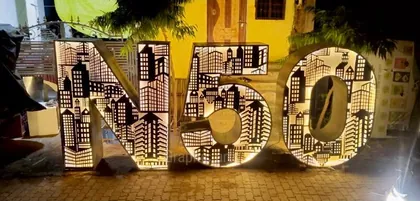
Yes. We fabricate at the Varanasi studio and install across Uttar Pradesh and beyond; our N50 metal installation was placed in Noida. Monumental work is built in sections and assembled on site.
Do you handle installation, or only fabrication?
Both. Design, fabrication, transport and on-site installation are carried out by us rather than subcontracted, which removes the coordination gap that causes most problems on public art projects.
Can you work to an architect’s or designer’s drawings?
Yes. We regularly fabricate to supplied drawings, and we can equally develop a design from a brief. If we see a technical problem — wall loading, lighting, a fixing detail — we raise it, but the design decision stays with you.
How do I get a quote?
For sculpture and murals we need six things: the scale, the site and its exposure, whether a specific likeness is required, the finish, whether plinth and foundation are in your scope, and the date. For printing, the file and the quantity are usually enough.
By service
All Categories of Sculpture
Which material should I choose for my sculpture?
It depends on where it is going. FRP for anything large that must be installed without a crane, or for interiors. Cement modelled in place for relief on a permanent wall. Fabricated metal for landmark pieces with integrated lighting. Reclaimed scrap where the material itself is part of the message. Tell us the site and the exposure and we will recommend rather than sell.
How large a sculpture can you make?
Monumental. Large work is built in sections over an engineered mild-steel armature and assembled on site, which avoids the heavy foundations and crane access that stone or solid bronze would demand at the same height.
Do you install, or only fabricate?
Both. Design, fabrication, transport, plinth fixing and installation are carried out by us rather than subcontracted, which removes the coordination gap where most public art projects run into trouble.
Can you work to an artist’s or architect’s design?
Yes. We fabricate to supplied drawings regularly. If we see a technical problem — a span that needs more structure, a fixing that will not hold, a finish that will not survive the exposure — we raise it, but the design decision stays yours.
Scrap Metal Sculptures
Which company can make a scrap metal sculpture for a municipal park?
Graphic Arts in Varanasi builds monumental scrap material sculpture for municipal and public sites, working either from scrap supplied by the corporation or from material we source. We are a GST-registered advertising agency operating since 1999 — the classification through which most municipal beautification work is tendered in Uttar Pradesh.
Can we supply our own scrap from municipal yards?
Yes, and it is often the better route — it strengthens the sustainability story and reduces cost. Involve us before collection begins so the material gathered actually suits the intended form; short rigid components cannot make long flowing curves.
How long does a scrap sculpture last outdoors?
Indefinitely with basic care. The structural frame is treated against corrosion, and the scrap surface is either clear-sealed or allowed to weather as part of the look. Annual inspection of welds and fixings is the only real requirement.
Is it safe in a public park?
Yes, when detailed for it — which we treat as part of the job rather than a finishing touch. Edges ground back at reachable height, no gaps that can trap a hand or foot, cavities sealed against standing water, and foundation anchoring engineered for wind and for climbing.
Metal Cast Sculptures
Who made the N50 installation for Noida’s 50 year celebration?
The N50 metal cast installation was fabricated by Graphic Arts, the public art studio at Lanka, Varanasi. It is a cut-metal typographic piece with a cityscape worked into the numeral faces, internally lit for night viewing.
Can you make an illuminated landmark for our city or campus?
Yes — city-name markers, anniversary numerals and campus landmarks are core work. Lighting is designed in from the start rather than bolted on. Give us the site, the sight-lines and the available power and we will work up a proposal.
How are these installations secured?
Foundation-anchored or ballasted depending on the site, and always engineered for local wind loading. For public plazas we also detail out sharp edges at hand height and seal all electrical work with separate maintenance access.
FRP Sculptures
How long does an FRP statue last outdoors in Indian weather?
Well over a decade in North Indian conditions with a UV-stable top coat. The composite itself does not rust, rot or absorb water — what ages is the surface coating, and re-coating every five to seven years keeps a piece looking new almost indefinitely.
Is FRP strong enough for a large public sculpture?
Yes, when engineered for the span. Beyond about eight feet an internal mild-steel armature carries the structural load while the FRP shell forms the surface. That is what allows twenty-foot-plus figures to stand safely in open, wind-exposed sites.
Can you match a specific person’s likeness?
Yes. Portrait statues are sculpted from photographs, ideally several angles plus any video. We present a clay head for approval before committing to the full-size piece, so likeness is agreed before the expensive stage begins — corrections in clay are cheap, corrections in finished FRP are not.
How long does an FRP commission take?
Lead time follows scale and finish rather than queue position. Moulding and curing are time-bound chemical processes and cannot be compressed, so we give a firm schedule at quotation and plan installation around it. If the date is fixed by an inauguration, say so at the outset.
FRP Murals
Can a fiber mural be fixed to a normal plastered wall?
Yes, in almost every case. That is the main practical advantage of casting a relief in FRP rather than cement or stone — the panels are light enough to fix to ordinary internal walls without adding structural support.
What is the best material for a 3D mural in a hotel lobby?
Cast fiber (FRP) in most cases. It is light enough for standard internal walls, it holds fine detail, and it accepts any finish from antique bronze to full colour. Cement or stone relief is heavier and generally reserved for exterior or structurally suitable walls.
Can you work to our architect’s design?
Yes, and we do it regularly. We can also develop the composition ourselves from a brief. Either way a scale visual is approved before sculpting begins.
How are the joints between panels handled?
Dressed and touched in on site, so a multi-panel composition reads as a single continuous surface rather than a set of tiles. It is worth asking any supplier how they handle this — it is where a large mural is made or ruined.
Cement Murals
Is a cement mural made in the studio or on site?
On site, always. The mortar is applied to your wall and modelled in place while workable, so the relief becomes part of the wall structure. That is what distinguishes it from a cast panel made in the studio and fixed on afterwards.
Can a cement mural be done on an exterior wall?
Yes — it is one of the most durable options for exterior relief, since there is no panel or fixing to fail. The wall needs to be structurally sound and correctly prepared first, and that preparation is what determines how long the work lasts.
Which is better for my project, cement or fiber?
Cement for permanence, weight of appearance, and exterior walls that will never change. Fiber for interiors, for speed, for lightweight fixing, and when the piece might need to move. Our material comparison guide sets out the full trade-off.
Wall Paintings
How long does an exterior wall painting last?
Five to eight years is typical for exterior-grade acrylic on a properly prepared and primed wall, and longer where the wall is sheltered from direct sun and driving rain. The variable is nearly always preparation rather than paint — an unprimed or damp substrate will shed paint within a season.
Can you paint a full multi-storey building?
Yes. Facade murals at full building height are regular work, executed by rope access. What we need up front is the elevation, a clear picture of obstructions on the wall, and confirmed permission from the building owner or society.
Do you take on multi-wall municipal beautification programmes?
Yes — a coordinated programme across many walls is a common brief. We develop a single design language and execute it consistently across the whole set of surfaces so the scheme reads as one intervention.
Interior Decorative FRP Materials
Can decorative FRP be fixed to a false ceiling?
Usually yes — that is much of the point of using it. FRP elements are a fraction of the weight of the plaster or stone equivalents, so cornices, roses and dome features can go onto standard suspended ceilings. We confirm the fixing method against the actual ceiling construction before casting.
Can you produce a repeating run of identical elements?
Yes, and this is where FRP is most economical. The cost sits in making the pattern and mould; once those exist, additional castings are comparatively cheap. A long run of columns, brackets or screen sections is straightforward.
Can it be supplied unfinished for site painting?
Yes — we can deliver in a paint-ready primer if the contractor is finishing to a site scheme. Most clients prefer us to finish it, because metallic and antique effects are difficult to match on site.
UV Printing
What surfaces can UV printing be done on?
Rigid and non-absorbent materials that conventional printing cannot handle — acrylic, aluminium composite, foam board, rigid PVC, wood, MDF, glass and tile among them. Because the ink cures on contact rather than soaking in, the surface does not need to be porous.
Is UV printing suitable for outdoor signage?
Yes. The cured ink film is considerably more resistant to sunlight, moisture and handling than solvent or water-based prints, which is why it is a common choice for exterior signage and panels.
Can you print a single piece?
Yes. There is no plate or setup cost, so a single panel is economical in a way offset printing never is. One-off and personalised items are routine.
Offset Printing
What is the difference between offset and digital printing?
Offset makes a physical plate for each colour, so there is a setup cost but a very low cost per copy — it wins at volume. Digital has no plate cost, so short runs and single copies are economical, but the cost per copy stays roughly flat as quantity rises. Tell us the quantity and we will tell you which is cheaper for your job.
What quantity makes offset worthwhile?
There is no single number — it moves with size, paper, number of colours and finishing. As a rule of thumb, a few hundred copies usually still favours digital, and a few thousand clearly favours offset. Send us the specification and we will price both.
Do you handle finishing and binding?
Yes — lamination, UV, foiling, embossing, die-cutting, and binding from saddle-stitch through to hard case. It is all part of the same job rather than something you have to arrange separately.
Book Printing
Can I print just one copy of a book?
Yes. Digital printing has no plate cost, so a single copy is entirely economical. That said, it is usually cheaper per copy to print all the copies you will need in one run than to come back for more later.
Which binding should I choose?
Perfect binding for ordinary paperbacks. Section-sewn where the book will be opened flat and used for years — it costs more and lasts far longer. Hard case for institutional, commemorative and library copies. Spiral for working manuals. Tell us how the book will be used and we will recommend.
Should I supply Word or PDF?
PDF, always. Word documents re-flow on a different machine with different fonts installed, so pagination shifts and your contents page stops matching. Export to PDF, embed the fonts, and check it before sending.
Coffee Table Books
What paper should a coffee table book be printed on?
Heavy coated art paper, generally 130 gsm and upward for text pages with heavier stock for the cover. It holds ink density on large images and stops show-through from the reverse — which is the most common thing that makes an otherwise good book feel cheap.
Why does binding matter so much for this kind of book?
Because images run across the spread. Section-sewn binding lets the book open genuinely flat, so an image crossing the gutter is not swallowed by the fold. Perfect binding is cheaper but does not open flat, and on a large-format image-led book that difference is immediately visible.
Can you handle the photography as well?
Yes. Photography, layout, printing and binding can all be handled here, which means an image that will not reproduce well gets caught at layout stage rather than after the run is printed.
Canvas Printing
What resolution do I need for a canvas print?
It depends on the finished size — the larger the canvas, the more pixels you need. Send us the original file rather than a WhatsApp copy, which is heavily compressed, and we will tell you the largest size it will hold up at before anything is printed.
Will a canvas print fade?
Pigment inks are fade-resistant and will hold for years in normal indoor conditions. Direct sunlight will shorten that for any print regardless of process, so avoid hanging a canvas where the sun falls on it for hours a day.
What is a gallery wrap?
The image continues around the sides of the stretcher frame, so the piece is finished on every face and needs no external frame. If the image is tightly composed and cannot afford to lose that border, we can mirror the edges or use a solid colour instead.
Materials, cost & commissioning
FRP vs GRC vs Cement: Choosing a Material for Outdoor Sculpture in India
What is the difference between FRP and GRC?
The difference between FRP and GRC is what the shell is made of, and everything else follows from that. FRP is glass fibre in resin — a plastic composite, very light, takes any finish including metallics, and relies on a surface coating that needs renewing every five to seven years. GRC is glass fibre in a cement matrix — a mineral surface that genuinely reads and weathers as stone, heavier than FRP but far lighter than solid concrete, and needing no re-coating. Choose FRP when weight or finish is the constraint, GRC when the piece must look like stone and survive decades unmaintained.
Which lasts longer outdoors, FRP or GRC?
GRC has the longer unmaintained life, because it is a mineral surface that weathers into patina rather than a coating that eventually degrades. FRP can match or exceed it in practice, but only with periodic re-coating every five to seven years. If the piece will realistically never be maintained, specify GRC.
Is FRP a cheap substitute for bronze?
It is far cheaper, but "substitute" undersells it. FRP allows scale that bronze makes financially impossible for most public budgets, and it removes the foundation, crane and installation costs that often exceed the sculpture cost itself. For a monumental figure it is frequently the better engineering answer, not merely the cheaper one.
Can these materials be combined in one project?
Regularly, and often they should be. A single scheme might use GRC for exposed exterior relief, FRP for a large freestanding figure, and carved cement for a permanent feature wall — each doing what it is best at.
What Drives the Cost of a Custom Statue in India
How much does a 10 foot fiber statue cost in India?
There is no single figure, because a ten-foot statue can vary several-fold in price depending on finish, whether a portrait likeness is needed, the internal structure the site demands, and whether the plinth, foundation and installation are included. Height alone determines only part of the cost. For a real number, give a fabricator the height, the site conditions, the finish and the likeness requirement — those four answers are enough to quote against.
Is a taller statue proportionally more expensive?
No — it rises faster than proportionally. A figure twice as tall has roughly eight times the volume, and the internal structure has to grow more than proportionally to carry it. Going from six feet to twelve is a much bigger step than the doubling suggests.
Does a portrait likeness cost more than a generic figure?
Yes. Likeness requires a sculpted clay original, review against reference photographs, and usually revision cycles before approval. That is skilled time before fabrication even begins, and it is time well spent — an approved clay head is far cheaper to correct than a finished statue.
How to Commission a Public Sculpture: A Step-by-Step Guide
How long does commissioning a public sculpture take?
Plan in months rather than weeks, and note that approval cycles usually consume more of the calendar than fabrication does. Moulding and curing are chemical processes on fixed timescales and cannot be compressed, so the realistic way to protect a fixed unveiling date is to shorten the decision stages, not the making.
Who is responsible for permissions?
Normally the commissioning body, since permissions attach to the site and the client controls it. Agree this explicitly at contract stage — it is a common and avoidable dispute.
What should be in a public art contract?
Scope with dimensions and material specified, the approval stages and who signs off each one, the payment schedule tied to those stages, who supplies the plinth and foundation, installation responsibility, warranty terms, and maintenance guidance at handover.
Maintaining Outdoor Sculpture in Indian Conditions
How often should an outdoor FRP sculpture be re-coated?
Every five to seven years in typical North Indian exposure, and sooner for a piece in full unshaded sun or heavy pollution. The signals to watch for are chalking, loss of gloss, and colour fading — re-coat when they appear rather than waiting for a fixed date.
Can a damaged public sculpture be repaired in place?
Usually yes. FRP is straightforward to repair — damage is cut back, re-laid and re-finished, and a good repair is invisible. Cement relief is patched and re-modelled in place. Only severe structural damage requires removal.
What is the cheapest way to keep public art looking good?
Washing it. Two or three plain-water washes a year, done properly, prevent more deterioration than any other intervention, and cost almost nothing compared to restoring a neglected piece.
Scrap Metal Sculpture for Municipal Parks: A Guide for Urban Local Bodies
Which company can make a scrap metal sculpture for a municipal park?
Graphic Arts in Varanasi builds monumental scrap material sculpture for municipal and public sites, working either from scrap supplied by the corporation or from material we source. We are a GST-registered advertising agency operating since 1999, which is the classification through which most municipal beautification work is tendered.
Can we supply our own scrap from municipal yards?
Yes, and it is often the better route — it strengthens the sustainability story and reduces cost. Involve the fabricator before collection so the material gathered actually suits the intended form.
How long does a scrap sculpture last outdoors?
Indefinitely, with basic care. The structural frame is treated against corrosion, and the scrap surface either gets a clear seal or is allowed to patinate as part of the aesthetic. Annual inspection of welds and fixings is the only real requirement.
Choosing a 3D Wall Mural for a Hotel or Restaurant
What is the best material for a 3D mural in a hotel lobby?
Cast fiber (FRP) in most cases. It is light enough to fix to standard internal walls without structural reinforcement, it holds fine detail, and it accepts any finish from antique bronze to full colour. Cement or GRC relief is heavier and generally reserved for exterior or structurally suitable walls.
How is a large mural fixed to the wall?
Mechanically — either battens or direct anchors, depending on the wall and the panel. Joints between panels are dressed and touched in on site so the finished composition reads as a single continuous surface rather than a set of tiles.
Can a mural be designed around existing features like doors or lighting?
Yes, and it usually should be. Designing the composition around openings, switches and fixtures gives a far better result than trying to hide them or pretending they are not there.
Start a project
Tell us the site, the scale and the date it needs to be in place. We will tell you what is achievable and what it involves.