
FRP Murals
Cast fiber relief murals are three-dimensional wall panels — sculpted, moulded and finished in our Varanasi studio, then mounted on site. Because each panel is a lightweight FRP shell, large relief compositions can be fixed to ordinary plastered walls without structural reinforcement.
What a cast relief mural is
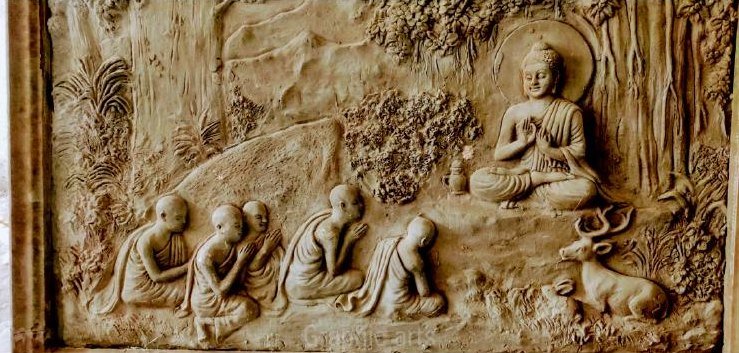
A relief mural sits between sculpture and painting: the composition projects from a flat background, so it reads through light and shadow rather than colour alone. It is sculpted full-size in clay, moulded, then cast in FRP as one panel or an interlocking set.
Panels arrive finished. Fixing is mechanical — battens or direct anchors — and joints are dressed and touched in on site so the composition reads as one continuous surface.
Why fiber rather than carved stone or cast cement
Weight decides it indoors. A stone or cement relief of any size imposes a load most internal partition walls cannot take without reinforcement — which means structural work, cost and delay. An FRP panel of the same visual scale fixes to a standard wall.
FRP also takes fine detail crisply and holds it, because the mould captures whatever the clay original carried: drapery folds, facial modelling, foliage.
Lighting is half the result
Relief reads through shadow. Light placed close to the wall and raking across the surface at a shallow angle gives the strongest result; flat frontal light removes the depth entirely. We advise on fixture positions at design stage, before the electrical layout is frozen — this is the single most common reason a well-made relief mural disappoints.
Materials
- Glass fibre and resinThe cast panel itself — light enough for standard walls
- Gel coatSurface taken directly from the mould
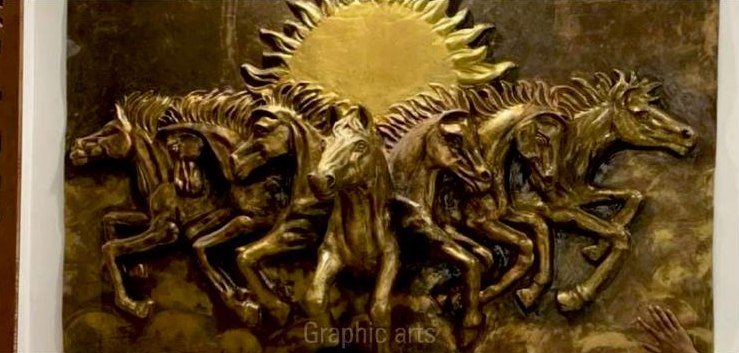
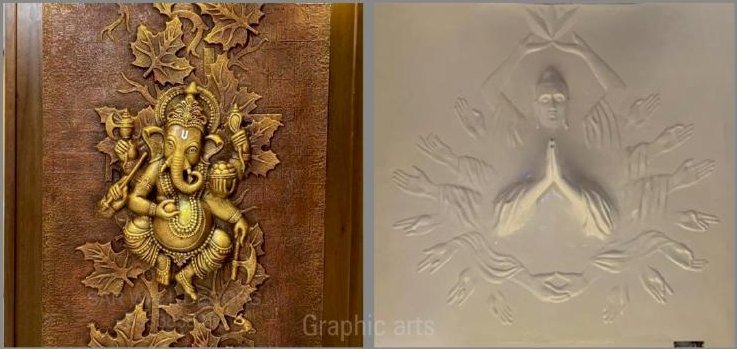
- Metallic and gilded finishesAntique bronze, brass, gold leaf effect
- Polychrome paint systemsWhere colour carries the composition
- Mechanical fixingsBattens or direct anchors, no adhesive-only fixing
Applications
- Hotel lobbies and reception feature walls
- Restaurant and banquet hall interiors
- Temple and meditation hall interiors
- Corporate reception and boardroom walls
- Institutional entrance halls
- Residential feature walls
Selected work
How the work is delivered
- Confirm the wall construction and what load it can take.
- Composition developed to your brief or your designer’s drawing, at true scale.
- Agree lighting positions before the electrical layout is finalised.
- Full-size clay original sculpted, then approved.
- Moulding and casting in FRP, as one panel or an interlocking set.
- Finishing to an approved physical sample, not a photograph.
- Mechanical fixing on site, joints dressed and touched in.
Frequently asked questions
Can a fiber mural be fixed to a normal plastered wall?
Yes, in almost every case. That is the main practical advantage of casting a relief in FRP rather than cement or stone — the panels are light enough to fix to ordinary internal walls without adding structural support.
What is the best material for a 3D mural in a hotel lobby?
Cast fiber (FRP) in most cases. It is light enough for standard internal walls, it holds fine detail, and it accepts any finish from antique bronze to full colour. Cement or stone relief is heavier and generally reserved for exterior or structurally suitable walls.
Can you work to our architect’s design?
Yes, and we do it regularly. We can also develop the composition ourselves from a brief. Either way a scale visual is approved before sculpting begins.
How are the joints between panels handled?
Dressed and touched in on site, so a multi-panel composition reads as a single continuous surface rather than a set of tiles. It is worth asking any supplier how they handle this — it is where a large mural is made or ruined.
Start a project
Tell us the site, the scale and the date it needs to be in place. We will tell you what is achievable and what it involves.