
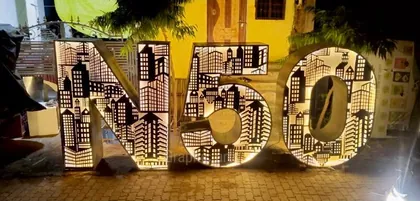
FRP Sculptures
FRP — fiber reinforced plastic, commonly called fiberglass — is the standard choice for large outdoor sculpture in India, because it gives the visual weight of bronze or stone at a fraction of the mass, cost and installation complexity. We sculpt, mould, cast, finish and install it in-house.
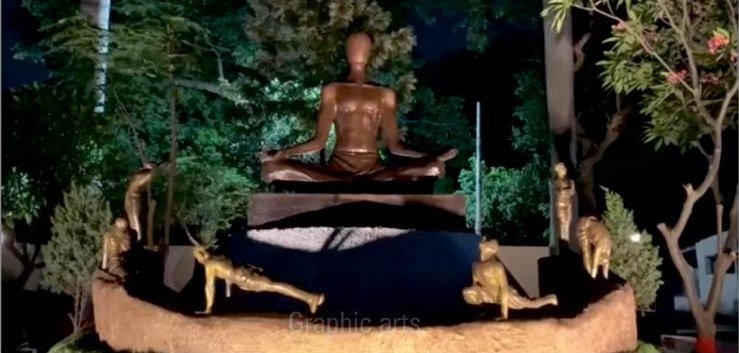
Why FRP is specified for large public work
A twelve-foot bronze figure weighs well over a tonne and needs a heavy foundation, a crane and often a road closure to install. The same figure in FRP typically weighs under 150 kg, can be lifted by a small team and mounts on a far simpler plinth.
For municipal parks, roundabouts, memorials and campus installations, that difference decides most project budgets — and it is frequently the better engineering answer, not merely the cheaper one.
Structure at scale
FRP is a shell, not a solid. Beyond about eight feet we build an internal mild-steel armature that carries the structural load while the composite forms the surface. That is standard practice for monumental work and is what lets twenty-foot-plus figures stand safely in open, wind-exposed sites.
Finish and lifespan
FRP takes any finish — antique bronze, gilded, stone effect, or full polychrome. Outdoors it holds up for well over a decade with a UV-stable top coat; the composite does not rust, rot or absorb water. What ages is the coating, so re-coating every five to seven years effectively resets the piece.
Materials
- Glass fibre mattingLaid up in layers inside the mould
- Polyester or epoxy resinThe binding matrix of the shell
- Gel coatThe finished outer surface, taken from the mould
- Mild-steel armatureInternal structure beyond roughly eight feet
- UV-stable clear coatProtects the finish on outdoor work
Applications
- Public parks, squares and roundabouts
- Memorials and commemorative statuary
- Temple precincts and devotional figures
- Campus and institutional installations
- Hotel grounds, lobbies and courtyards
- Portrait statuary where likeness must be exact
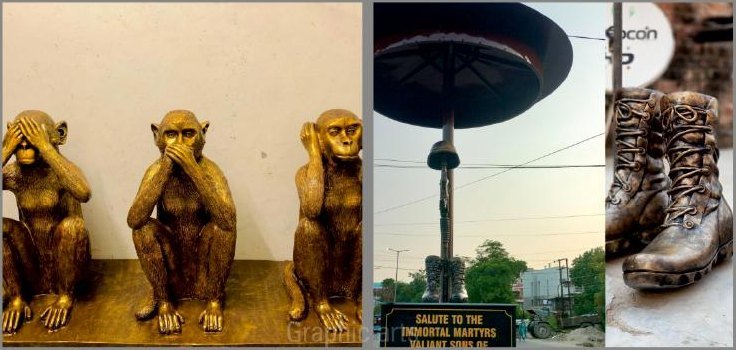
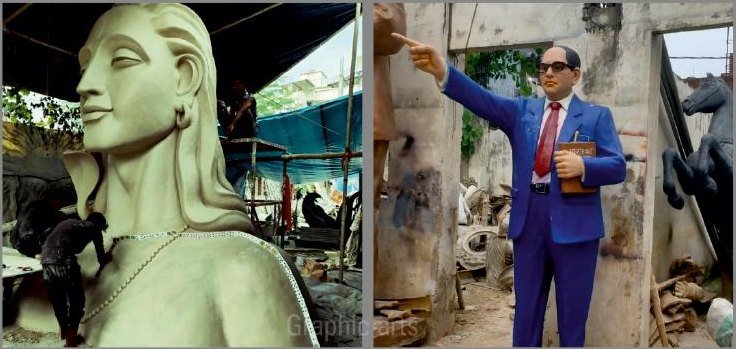
Selected work
How the work is delivered
- Brief, reference photographs and site details.
- Scale maquette or full-size clay head for approval before full-size work starts.
- Full-size clay or plaster original, sculpted by hand.
- Silicone or fibreglass piece-moulds taken from the original.
- Lay-up — glass matting and resin built up in layers over an armature where needed.
- De-moulding, seam dressing, sanding and gel-coat.
- Surface treatment, then a UV-stable protective coat for outdoor pieces.
- Transport, plinth fixing and installation.
Frequently asked questions
How long does an FRP statue last outdoors in Indian weather?
Well over a decade in North Indian conditions with a UV-stable top coat. The composite itself does not rust, rot or absorb water — what ages is the surface coating, and re-coating every five to seven years keeps a piece looking new almost indefinitely.
Is FRP strong enough for a large public sculpture?
Yes, when engineered for the span. Beyond about eight feet an internal mild-steel armature carries the structural load while the FRP shell forms the surface. That is what allows twenty-foot-plus figures to stand safely in open, wind-exposed sites.
Can you match a specific person’s likeness?
Yes. Portrait statues are sculpted from photographs, ideally several angles plus any video. We present a clay head for approval before committing to the full-size piece, so likeness is agreed before the expensive stage begins — corrections in clay are cheap, corrections in finished FRP are not.
How long does an FRP commission take?
Lead time follows scale and finish rather than queue position. Moulding and curing are time-bound chemical processes and cannot be compressed, so we give a firm schedule at quotation and plan installation around it. If the date is fixed by an inauguration, say so at the outset.
इस पृष्ठ का हिन्दी संस्करण: हिन्दी में पढ़ें
Start a project
Tell us the site, the scale and the date it needs to be in place. We will tell you what is achievable and what it involves.